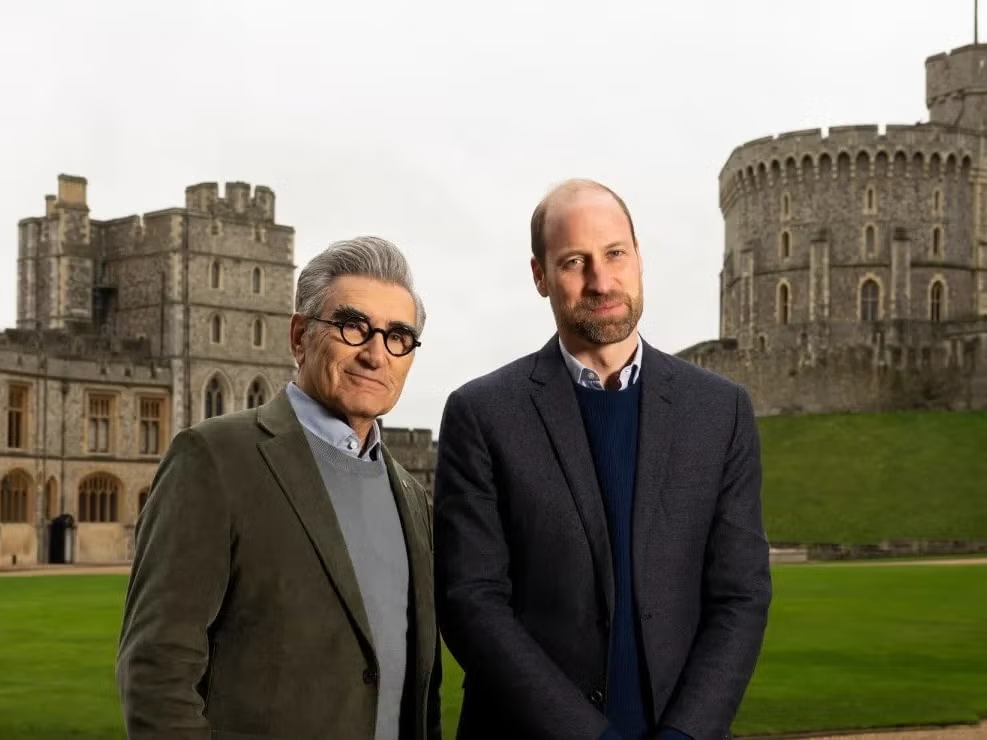
The King and Queen make an historic visit to the Vatican with the King, head of the Church of England praying publicly with the Bishop of Rome. William gives a controversial – and unexpected – interview to Eugene Levy and hints at changes to come under his watch. Join us as we review the Royal month that was October. We also spoke to Royal historian Gareth Russell about the North America release of his groundbreaking book: “The Six loves of James I”. In order to prevent this month being dominated by the fall of Andrew Mountbatten Windsor, we have released a separate podcast exploring that topic.
To prevent our October 2025 “Royal roundup” being dominated by the fall of the Yorks, we have devoted an entire bonus episode to the topic. We discuss the events that led up to Andrew’s fall, the sanctions placed upon him and impact on the future of the monarchy. Apologies for the slightly dodgy sound in places. Hopefully it doesn’t impact enjoyment.
Join us as we review the Royal comings and goings of September 2025. From the sad death of the Duchess of Kent to the bells and whistles of Trump’s state visits, September was saturated with Royal news. The Duke and Duchess of Sussex were back in the headlines. Toward the end of the month, the Duchess of York saw any credibility she had managed to claw back crumble as unfortunate emails came back to haunt her.
In this month’s “history corner” we spoke to Dr Elizabeth Norton, author of “Women Who Ruled the World: 5000 years of female monarchy.
In the final part of our series on the Abdication crisis of 1936, we answer your questions. With Royal History Geeks creator, Gareth Streeter and Royal commentator, James Taylor.
The reign of King Edward VIII is over. Now, the newly created Duke of Windsor begins his exile. Painfully for Edward, he must wait several long months before he can make Wallis his Duchess. This episode briefly explores the aftermath of the Abdication crisis.
During this episode, RHG founder Gareth Streeter and Royal commentator James Taylor explore:
The immediate ‘logistics’ around the Duke’s relocation
A glimpse of happiness at the end of the worst year of Queen Mary’s life
The controversy around the Windsor’s wedding, the date and the lack of Royal attendance
The (questionably legal) decision to deny Wallis the HRH style
The Duke and Duchess’s Nazi links and role in the war
The “snub” to the Windsor’s at Princess Elizabeth’s wedding
The ultimate death of the Duke and later the Duchess
After six weeks of build up, it is finally time to explore the actual Abdication of Edward VIII – the only truly voluntary surrendering of the throne in history.
It this episode, RHG founder Gareth Streeter and Royal commentator, James Taylor explore:
The “last supper” where the Prime Minister tries to convince the King to stay but is denied a bed for the night
The Duke of York and his last-minute preparations for the crown
The Cabinet’s rush to prepare the legislation for Abdication
Baldwin’s surprisingly spectacular Commons performance and the beginnings of the romantic myth of the crisis
Queen Mary’s subtle sign of support for the government
The arrangements for Edward’s future including title and income
Edward’s master piece of a broadcast to the nation
Although Edward has now left the throne, this is not the end of the series. Next week we shall explore the aftermath.
In this episode we pause the continuity of the crisis to take a look at how the events of 1936 affected members of the Royal family. Despite it having huge repercussions on their lives, Britain’s premier pedigree were not major players in the crisis (apart from the King, of course). However, this is a ROYAL history podcast so we wanted to take a moment to look at events from the family’s vantage point.
In this episode, RHG founder Gareth Streeter and Royal commentator James Taylor discuss:
Queen Mary, her background and reaction to the crisis
The Duke and Duchess of York’s fears as they prepare to assume power
The beginnings of the Duchess of York’s (later Queen Elizabeth, the Queen Mother) feud with Wallis Simpson
The closeness between Edward VIII and Princess Mary, the Princess Royal
The wayward Duke of Kent and how some thought he should be King
The cool relationship between Henry, Duke of Gloucester and his eldest brother
This episode also features comments by Elizabeth Basford, author of “Princess Mary: The First Modern Princess.”
When the story of the King’s relationship with the twice-divorced Wallis Simpson broke in the press, Edward VIII believed his abdication was inevitable. But for a brief moment on the 4th and 5th of December, it looked as if a flicker of public support might light a path for his survival.
In the latest episode of “Royal Revolutions”, RHG founder Gareth Streeter and Royal commentator James Taylor discuss:
Wallis’s tumultuous escape from Britain to France
The motivations of the King’s supporters
The media reaction and hints of public support for the King
Why Harry Enfield ruined a teenage Gareth’s life back in the 90s
Wallis’s latest attempts to break it off with the King
The King’s planned broadcast appeal to the nation that never aired
Baldwin’s fears of the constitutional settlement being overturned
Winston Churchill’s outspoken role in the crisis
Concerns about the legality of Wallis’s divorce
We are again joined by historian Adrian Phillips who helps us make sense of what the so-called “King’s Party” was.
Until recently I’d never given Wallis Simpson any serious thought.
As a Royal history geek from a young age, I encountered her role in the origin story of Elizabeth II, but by the time I was old enough to digest any relevant comment, the “what a wicked woman that stole the King away” narrative had largely dissipated. The 90s, compared to previous decades, was a more sympathetic time.
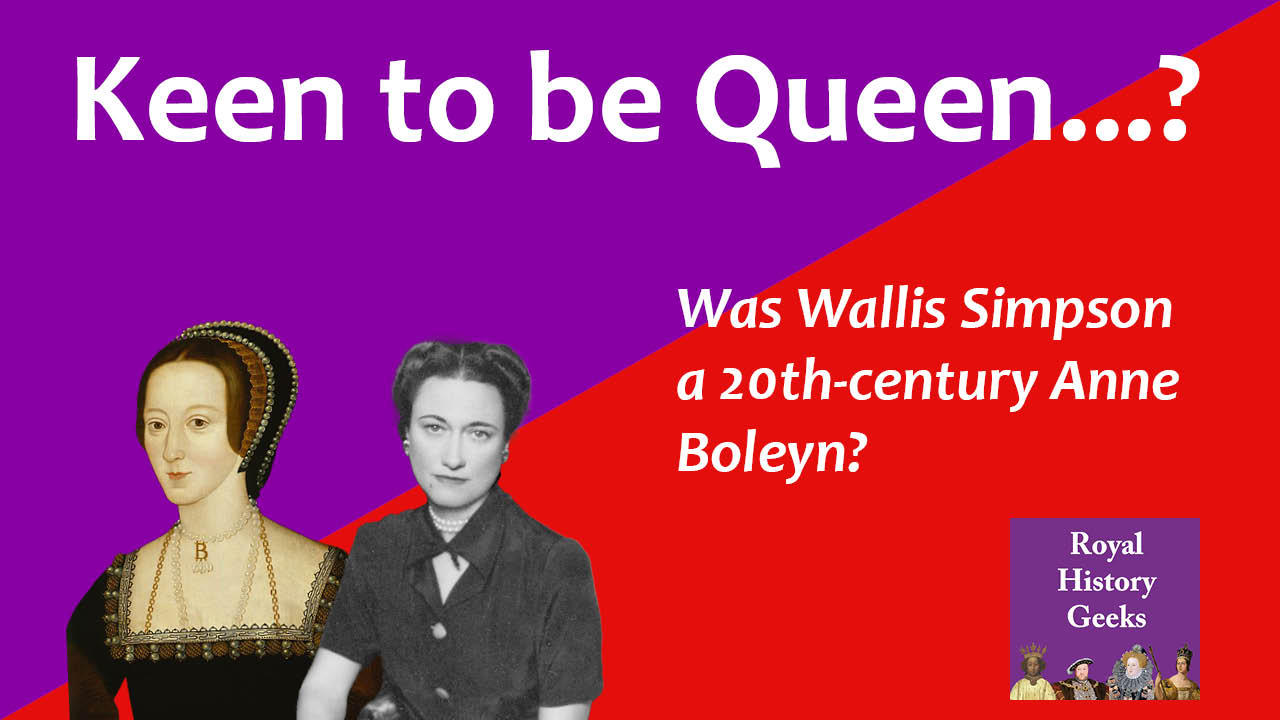
Subconsciously, I think I had viewed her as a kind of 20th-century Anne Boleyn. She was supposedly not conventionally beautiful so there must have been something captivating about her that could tempt a King away from the lures and responsibility of ruling his empire. I assumed that like Anne, she must have been a sparkling intellect, an unapparelled wit and a woman of fierce ambitions.
Devoted Royal history geeks will know that we are currently in the midst of a podcast series on the Abdication crisis. While studying sources and scholarship, I’ve had big reasons to doubt this take on Wallis. Here are three reasons why:
Even Anne Boleyn’s fiercest critics would concede that the ill-fated Tudor Queen was a woman of impressive intellect. With Wallis, there is little sign of much intellectual curiosity. She certainly appealed to Edward VIII through her directness and – most importantly – her willingness to put him down. But while Henry VIII was a reasonably clever man that required a very intellectual woman to outsmart him (as both his first two wives seem to have done), getting one over on Edward VIII was a much easier task
Historians and enthusiasts debate the extent to which Anne Boleyn pursued a political agenda but I would argue she was a driving force behind religious reform. Wallis seems to have no real political or societal agenda. She may have wanted to be Queen when she thought it required little beyond wearing jewellery and entertaining friends at a palace but she seems to have shrunk away from any role in public life. Years after the abdication, when asked about pressing social issues, she talked about the plight of rich widows who now received fewer dinner invitations. A social reformer, she was not
Anne also understood politics. Yes, she ultimately came undone through a political miscalculation to take on Cromwell. But this was after years of successfully using every tool at her disposal to get what she wanted, even when she had to move heaven and earth to do so. Wallis, as one half of the doomed duo known as “Wallis and Edward”, habitually misread the public mood and made huge political errors. Though I reserve the right to change my mind, I currently view the couple’s Nazi associations as an example of complete naivety, selfishness and foolishness rather than an act of decided political calculation
Do check out the first season of “Royal Revolutions” to join us as we journey through the tumultuous events of 1936…
As Wallis Simpson awaits her divorce hearing, the Prime Minister, Stanley Baldwin, pleads with Edward VIII to change course. From that moment, the relationship between the King and Mrs Simpson becomes an official issue of government business and the event can truly be called a constitutional crisis.
In the latest episode of our series on the abdication crisis, James Taylor and Gareth Streeter discuss:
The King’s attitude toward the Prime Minister and the government
Wallis’s divorce and the fallout
The King’s dinner with Queen Mary, when he broke the news that he intended to marry Mrs Simpson
The idea of a morganatic marriage and the attempts to find a compromise
A controversial speech by an obscure Bishop
The breaking of the story in the press
We were also joined by historian Adrian Phillips to learn more about Stanley Baldwin and his attitude toward the crisis.